
King, Warrior, Magician, Lover (KWML) – archetypes of the mature Masculine
by Eivind Figenschau Skjellum
A brief introduction to the KWML archetypes of the mature masculine

The seminal work by Robert Moore and Douglas Gillette that underlies this article.
As any man with life experience knows, life is a constant struggle wherein the desired goal is our attainment of inner peace as well as the ability to give and receive love fearlessly. On this journey of discovery and growth, there are many forces within us that battle for attention. Our personality is not a single entity with one homogenous voice as much as it is a variety of different voices that battle for dominance. Sometimes unfamiliar voices may shock or delight, and sometimes worn out voices may become so irritating, so jarring, so profoundly removed from what we want to hear, that we come to hate ourselves.
One of the most important types of work we can can do in our growth into maturity is to identify and befriend these voices, so that they find and relax into their rightful place in what becomes an increasingly integrated psyche. Maybe we must tune some voices down, others a little up. Maybe we must make the baritone into a soprano, the bass into a tenor. Whatever voices are within us, our primary mission in life is to conduct them from being a cacophony to being a beautiful and powerful choir. Such important work requires a powerful framework, a model for teaching, learning, and living. That is why we will now dive into the deep waters of the archetypes known as King, Warrior, Magician, Lover (KWML).
Jung did very important, revolutionary work on the archetypes and the collective unconscious. In his work he speaks of the anima, the feminine within us, and the animus, the masculine within us. He further expounds that the anima and animus have four stages of development. And while these stages probably warrant an article unto themselves, Jung is merely mentioned in this context as a facilitator for the discovery of the KWML archetypes. Jung described four stages in his model, from immature to mature: Eve/Adam, Helen/Planner, Mary/Professor, Sophia/Guide as stages of an evolutionary path whereby the last stage is more evolved then the first. The KWML-model, on the other hand, attributes equal importance to all archetypes, claiming no superiority of one over another*.
* However, depending on cultural conditions, some archetypes may be more needed than others.
However, as outlined in the book King, Warrior, Magician, Lover – Rediscovering the archetypes of the mature masculine by Douglas Gillette and Robert Moore, there is a clear line drawn between immature archetypes – boy psychology – and mature archetypes – man psychology. In boy psychology, there is in the model a clearly delineated path of evolution, which yields to a more open landscape with the onset of man psychology. Additionally, within each of the four archetype axises, is not only an immature and a mature stage, but a pyramid structure of the boy and of the man wherein we find the integrated archetype at the apex, and active and passive bipolar shadow aspects in the left and right corners (fig. 1).
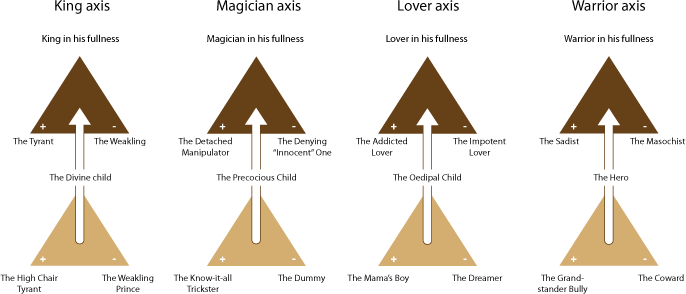 Fig. 1: The KWML model
It is important to recognize that when we are not in conscious relationship with an archetype, we are automatically ruled by its bipolar shadow. And when we are ruled by the shadow archetype, we tend to switch back and forth between the active and passive poles, completely at the mercy of events.
What we learn from this system is that healing and integration becomes possible when we recognize that one archetype dominates too strongly in our psyche, and must be balanced by another, or when we recognize that the archetypes we animate are sourced in the active or passive shadow poles, as opposed to the integrated and mature aspect.
Now, let’s take a brief look at what makes a boy before we look at the man and his archetypes up close.
Understanding the Boy
The differences between a boy and a man should be apparent, but in our current cultural climate, we seem to have lost this understanding. Boyhood has come to dominate the male population of Western culture, and manhood discarded as dark, destructive, scary, and problematic. The boy has been pushed to occupy the space left behind by the man – something he is not ready for – and his values of youth, physical vitality, and beauty come to dominate. He has been celebrated through diverse cultural phenomena, such as the boyband, young, rebellious athletes, the irresponsibility and «don’t give a damn»-attitude proselytized by the advertising industry (look no further than Coca Cola Zero adverts), the take-what-I-want-and-fuck-you-if-you-try-to-stop-me of parts of the music industry, the self-serving ways of young stockbrokers and real estate agents etc, the wave of movies in which immature men are turned into poster boys, the admiration of heroics, the celebration of youth over wisdom etc. The list goes on.
The problem with this is that we end up with a very limited view of masculinity, one rooted in insecurity and the desire for sex, fame, money, and power. We become so uprooted in ourselves, separated from our true core, that we define ourselves through external factors. We must recognize one basic fact: The boy is the slave of his ego. He often has little control over his nervous system, and fries his life energy on pointless mental pursuits and drama. He is the guy who can’t sit still and can’t tolerate silence. He is the guy who freaks out from prolonged eye contact. He is the guy who is easily insulted, who tries very hard to be seen (or equally hard not to be), who fishes for love and is easily hurt. He is the guy who has little structure and integrity in life, and who – despite his myriad claims to goodness – won’t stand up for a friend in times of need. It’s not that he doesn’t want to do the right thing. It’s that he is not able to. His life is in disarray and he is completely under the spell of the feminine, and is happy only as long as mummy is close. This is the subconscious mother, the archetypal mother, the feminine as a whole – not necessarily the biological mother. The purpose of the Hero archetype, the last archetype of boyhood psychology, is to break free from this bondage to the Feminine.
The first three archetypes of boyhood psychology are: The Divine Child, the Precocious Child, and the Oedipal Child. These, as well as the Hero, will be featured in detail later on. For now, I choose to focus on the man.
Understanding the Man
The hero’s journey – the last step on the evolution of boy psychology – finally takes the boy into the realms of the man. This, however, often comes at great cost, and is often preceded by a time of existential crisis, what Robert Bly refers to as «ashes work». In the legends, the story always ends when the hero returns having slain the dragon, rescued the princess, and received the kingdom as reward. It doesn’t describe the enormous difficulty the hero has settling into his adult responsibilities as king, and doesn’t investigate his ability to stay faithful to his new queen, or his inclination to throw it all away – all those nasty responsibilities – to ride into the world on his trusty stallion once more.
We said that the defining characteristic of the Boy is his enslavement to his ego. The defining characteristic of the Man is his mastery of it. The Man has subjugated his ego and turned it into an ally. This is impossible unless the crisis of ashes has first been lived or worked through. Any boy who is to become a man must feel his fearful way through the utter pointlessness of everything to serve the world. And it is of course exactly because our lives are so safe and comfortable that most of us never grow up to serve, never leaving boyhood behind.
Let’s look at the archetypes of the man, starting with the King, before we move on to the others. What follows are effectively summaries of the chapters in Robert Moore and Douglas Gillette’s book.
The King
The King is the source of order in the kingdom. If he is a wise and just king, the kingdom prospers, people eat well and are safe from harm. In the kingdom of the wise king, laughter rings through the lands, the crops shoot up high, joyful celebrations keep the woods awake, merchants travel with overflowing carts to lively markets. The king is the harmonizing principle, the subjugator of chaos, the uniter of opposites. He is the channel through which the gods communicate, and he channels divine blessings to his people and the lands (to whom he is «wed»). He is selfless, and puts the good of his people above his own needs. When the King grows weak, darkness threatens the borders of the kingdom, the sun disappears from the sky, and the crops wither and die. When the king dies, he knows, he is merely replaced by another in a lineage of divinely blessed kings, which humbles him (remember the saying «The King is dead, long live the King»).
In the psyche of the man, the King archetype is the central archetype, around which the rest of the psyche is organized. If the King energy in us is weak, our psyche falls in disarray, and chaos threatens our lands. The man who is constantly overwhelmed by life – who can’t seem to find harmony or order – must develop the King energy, often in conjunction with Warrior energy to protect his borders.
The two main functions of the King are:
- Live according to the Tao, the Dharma, the Word, and the lands will flourish
- Bring fertility and blessing. The King is the masculine equivalent of the Great Mother, and he is wed to the lands. The king’s vitality and sexuality directly reflect on his kingdom.
The Shadow King: The Tyrant and the Weakling
The Tyrant is the active pole of the Shadow King. The Tyrant, unlike the King, is not the harmonizing center of the kingdom, and his power is so fragile that he hates with a passion all new life; the beauty and purity of a mere baby boy threatens the Tyrant’s rule. He does not realize that a King is merely a channel, and wants the power to be associated with himself. He will even develop godly pretensions to cover up his enormous insecurity. His degradation of others and all beauty is limitless, as everything good, true, and beautiful reminds him of his own shortcomings. He is extremely sensitive to criticism, and will be deflated by the slightest remark, responding with rage, when what he feels is fear and vulnerability.
The Weakling is the passive pole of the Shadow King. He is not centered in himself and lacks inner peace and harmony, and is prone to paranoia. He suspects that those around him are disloyal, and his fear of betrayal will inevitably cause him to switch over to the Tyrant to control them.
The Magician
The Magician is the wise man, the sage, the knower of secrets. He sees and navigates the inner worlds, he understands the dynamics and energy flows of the outer. He is a master of technology, engineering, mathematics, mysticism, and logic. He reads the stars, navigates the soul, and writes the laws. In the legends, he is the King’s close advisor, who stops the regent’s anger with cool rationality before he acts rashly and channels to him knowledge from hidden sources. The Magician is the thinker, and all knowledge that requires special training is his domain. The Magician has the capacity to detach from events – the chaos of the world – and draw on essential truths and resources deep within him. He thinks clearly in times of crisis, and enables us to take a broader view of things. He governs the observing ego, and is the meditator that reveals the truth of the universe, the shaman who communicates with the ancestors and stars
The Shadow Magician: The Manipulator and the Denying «Innocent» one.
The Manipulator is the active pole of the Shadow Magician. He works in covert ways to undermine others. He withholds crucial information, and deliberately sets others up so as to appear inferior to himself. The specialist knowledge he possesses makes him feel proud and gives him a feeling of being better than. That feeling is all he lives for, so he is not prepared to share his knowledge, unless the price is right (and even then probably withholding crucial details). He will rather use it as a weapon, ready to strike when the impact is the most devastating.
The Innocent one is the passive pole of the Shadow Magician. He wants the status belonging to a true Magician, but he doesn’t want the responsibilities. He doesn’t want to be burdened with helping, of setting up sacred space for others’ learning. His main focus is to learn exactly enough to sabotage those who are trying their damndest to make a difference, so that no other man will achieve that which he is too lazy to strive for. He is envious of the vitality of others, because he is so «flat» himself. Whenever confronted with his elusive and destructive behaviour, he responds «who, me?». He is a master at manipulating others into thinking that it really wasn’t his doing, a carefully crafted puppet theatre conducted behind the smokescreen of the Manipulator.
The Warrior
The warrior is a powerhouse of energy, the source of which is a transpersonal commitment. He is fiercely loyal to his warrior code – which is his honor – and to the king, who mythologically represents his purpose. The warrior is not concerned about his own comfort and security in pursuit of his goal, as his training teaches him to live with death as his constant companion. The domain of the Warrior is the battlefield – be it a battlefield of war, of spirituality, or of moral ethics. The Warrior’s purpose is often to destroy, but the mature warrior destroys only that which is negative and harmful to the world. He is a master tactician, knowing at all times his limitations, and finds creative ways around them. The warrior is not a thinker, he is a doer. Thinking is his enemy, because it inhibits his ability to act swiftly and with force. He trains himself not to think, and becomes a master of his mind, attitudes, and body. The warrior is detached from life, with an almost infinite ability to withstand psychological and physical pain in pursuit of his goal. He is a little «unhuman», always chasing his next big goal, always putting emphasis on his mission as opposed to his relationships.
The Shadow Warrior: The Sadist and the Masochist
The Sadist is the active pole of the Shadow Warrior. The Warrior’s detachment from life leaves the door open to cruelty. The Warrior is most vulnerable in the area of relationships, where he must constantly stay vigiliant of his mind and emotions. They must not be repressed, but be under control, lest cruelty sneak into him while he isn’t looking. The Sadist hates weakness and vulnerability, which is a projection of his hidden Masochist, and will take great glee in tormenting those unfortunate souls that remind him of his shadow. The Sadist directed inwards has people running themselves into the ground out of deep anxiety. They have low sense of self-worth, and will endure great self-torment on their way to burnout.
The Masochist is the passive pole of the Shadow Warrior. The Masochist projects Warrior energy onto others, and experiences himself as impotent and vulnerable in their presence. He is unable to defend himself psychologically and allows others to manipulate and mess with him. A man might endure enormous amounts of abuse until one day he might snap, and percolate back to the Sadist.
The Lover
The lover is finely attuned to the realm of the senses and worships beauty. He is a musician, poet and artist, and a lover of all things, both inner and outer. He is passionate, and delights in touching and being touched. He wants to always stay connected, and does not recognize boundaries. He wants to experience the world as one ongoing big orgasm of hearts uniting as One. He is the mystic who feels everything as himself, and the source of all intuition. Through his feeling capacity, he is finely attuned to people’s energy, capable of reading them like an open book. His desire for love and connectedness considered, feeling into other people and discovering dark intentions is a painful experience for him. He is opposed to all structures that maintain separateness – of all law and order that keep hearts lonely and isolated. He is, in other words, opposed to all the other archetypes. The Lover is crucial in keeping the other archetypes energized, humane, and in touch with the ultimate purpose of love. The Lover keeps them from turning dark.
The Shadow Lover: The Addicted and the Impotent Lover
The Addicted Lover is the active pole of the Shadow Lover. He is constantly searching for the fulfillment of his sensual desires. A true hedonist, he throws himself into a neverending and exhausting search for sensual fulfillment, without ever really knowing what he truly looks for. He is pulled around by circumstances and his constantly shifting desires, never finding rest. A woman here, a women there, then music, art, fine wine – whatever keeps his sensual side alive. The Addicted lover has not solidified in his internal structures, and will forever hunt for the attainment of his desire, helplessly shackled to the desire for union with Mother (the realm of sensory experience is the realm of the Feminine).
The Impotent Lover is the passive pole of the Shadow Lover. He is chronically depressed, and feels cut off from himself and others. He loses his zest for life, his energy all but gone.He is sexually inactive, and will withdraw from all demands that are placed on him and his sexuality. If his partner becomes too demanding, requesting a sex life from him he is uncapable to offer, his feelings of imprisonment may propel him out of the relationship and onto the endless road of addiction that is the domain of the Addicted Lover.
Working with the archetypes
A September 2010 addition to this article, this conclusive part on working with the archetypes is needed for the reader who actually wishes to go further with this information. I have experienced something remarkable in studying the archetypes – where most conceptual learning has a tendency to make me feel heady and intellectual, reading about the archetypes has an odd pull downwards and inwards. It’s as if these ancient voices of archetypal, mythical men wants me to descend into the subterranean parts of my inner world. When I learned that the reptilian brainstem lights up when the archetypes activate in a person, it made perfect sense to me; these energies are ancient.
The quality of tuning into this material is unlike anything I have ever felt before − and I have studied a lot by now. My experience is that if we let ourselves soak in this material − let its wisdom seep into our pores − we will become prone to recognizing archetypal patterns in our daily lives. In that context, it’s vital to note, as previously suggested, that lest we have a conscious and mature relationship to the archetype, we are ruled by its bipolar shadow. In other words, the man who says such a thing as “I have no need for the Warrior archetype” is by default ruled by the bipolar sadist/masochist. A peace-loving, Warrior-denying hippie may for example be really strong on the masochist, touching his inner sadist on his more violent days.
Similarly, a stern, authoritarian patriarch faced with the challenge of expressing appreciation of beauty may think that is “for faggots”. Unfortunately, that will make him sexually impotent and/or frustrated and then when he’s tired of that, he may swing into the position of the Addicted Lover (sometimes this is the point at which a homophobe may “come out of the closet”, which may or may not be an authentic expression of his sexual identity. See American Beauty). It’s a painful fact that anything that is not brought into light ends up controlling our lives from the shadows. What we resist persists.
So in actually working with the archetypes, awareness of them is as always the first step. While an information product on how to work on the archetypes in our daily lives is in the pipeline, I want to outline a few practices and give some brief advice on how to identify which of your archetypes are healthy and which ones aren’t (we will often mature in the four archetypal quadrants in parallel, but there may be some discrepancies).
If you draw a blank when feeling into any of these archetypes, chances are its bipolar shadow is running your life. So that is the home work for now: pick one of the practices below (which facilitate growth and integration) and use them to develop that archetype in you which is most in need of growing up. And if you are so inclined, come back when more material is made available here. The newsletter (signup form in the sidebar) will help you keep up to date.
- King: Start a men’s group. Host a dinner party. Do a presentation in which you care more about the interiority of the members of the audience than looking good. Start seeing the impact you have on other people’s wellbeing and tune into the feeling that the people around you are citizens of your very own kingdom. They are in your care.
- Warrior: Take up martial arts. Exercise. Engage in a confrontation you have postponed. Always tell the truth. Maintain perfect integrity. Work on maintaining good boundaries.
- Magician: Do DIY engineering projects. Study the stars. Study the KWML archetypes. Study anything. Build a small laboratory and get to know the world of chemicals. Take up spirituality in order to penetrate the mysteries of the Cosmos. Teach something.
- Lover: Express your appreciation of beauty. Take up dance lessons. Do sensuality practices. Turn sex into your art. Listen to music that moves you (yes, move with it) and make really enjoying it a practice of presence (many people who “enjoy music” use it as a distraction from life. In practicing the Lover archetype, you should not). Start playing an instrument. Sing.
These are but a few ideas. Trust your intuition and get started. You cannot afford to let this opportunity pass you by.
Discuss the article below: